
Margarita With a Straw- A Desirable Drink
In the vein of Vikas Bahl’s Queen (2014) and Gauri Shinde’s English Vinglish (2012), Shonali Bose and Nilesh Maniyar’s Margarita With a Straw narrates the journey of a woman and underscores the shades of feminine beauty and bravery. Bollywood has witnessed women at the helm of directorial affairs with Zindagi Na Milegi Dobara (2011) and Main Hoon Naa (2004) mirroring the male fantasies and masculine aspirations. However, what distinguishes Margarita With a Straw is not merely its female protagonist and female central characters; the feminine sensibility dictates the narrative choices, shot taking as well as frame compositions.
The film centres round Delhi University student Laila (Kalki Koechlin) who suffers from cerebral palsy and is a lyricist for the college band. With a Punjabi father (Kuljeet Singh) and a Maharashtrian mother (Revathy), Laila’s family forms her emotional crutch along with the differently abled friend Dhruv (Hussain Dalal). Her stable life metamorphoses when she is accepted for a creative writing programme at the New York University, which allows her a new space for emotional and sexual exploration. The story ends with a return to India where new travails and triumph await her.

In a formula format where directors blur the difference between theater and film with excessive use of dialogues, Bose has made a marked deviation. She has created several and sustained scenes and sequences without dialogue and let the silence and the movement of the camera tell the story. The opening scene following the blue matador on the wide streets of Delhi with the mother at the driver’s seat breaks the stereotype of the middle class North Indian family. The sliding electric wheelchair for the differently abled Laila breaks the stereotype of a ‘normal’ family. The Asamese character of Nima (Tenzing Dalha) and the Pakistani character of Khanum (Sayani Gupta) further breaks the stereotype of what comprises an Indian cast. A single scene captures the challenge of the protagonist’s condition- when she has to be lifted up the flight of stairs to reach her classroom due to the breakdown of the elevator. The expression held by Koechlin in those few moments is one of the few most powerfully held emotions of anger and isolation. Silence in this film is truly golden.
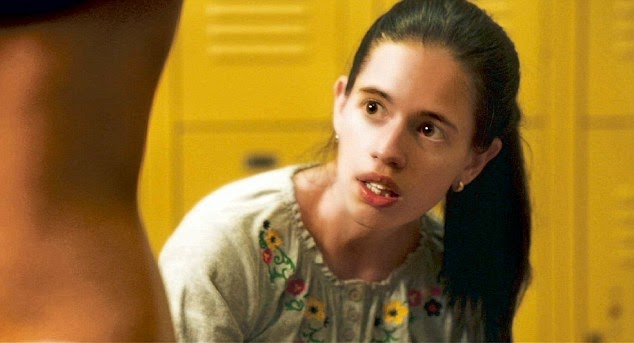
With the establishment of disability and dysfunction, Bose breaks the norm of garnering sympathy for the affected protagonist. This is achieved with the representation authentic trajectory that any other collegiate of Laila’s age would undergo- love, sex, music, friends, academics. Staring at college crushes, anxiety over Facebook profile pictures, kissing in alleys of Science labs and jamming with friends- Laila’s life unfolds like any other coming-of-age narrative. Even the acknowledgement of Laila’s disability at the inter-collegiate battle of the bands competition offends her and it echoes her self-respect loud enough. However, the director makes her lack of motor skill coordination as more of a deceptive cover used to explore a far bolder and truer taboo of society- the thick boundaries we draw between heterosexuality, homosexuality and bisexuality. While male sexual development and expression have often found on-screen expression and off-screen acceptance with movies like Hunterr (2015) and Desi Boyz (2011), the scene that captures Laila stimulating herself is one of the boldest scenes one has witnessed in the cinematic form.

What further aids the audience to feel the mood of the situation and the emotions of the characters is music. Right from the Punjabi song the father sings in the opening scene, which is replayed during the family dance before Laila’s departure to the USA creates a warm moment. The effectively penned “Meri Aadat Mera Hissa” serves to heighten Laila’s pain while the innovative “Dusokute” song is used to create a dramatic irony. Yet the most interesting twang to the tunes come in the scene where Laila and Khanum go drinking and dancing in a New York watering hole and sexual tension between the two women builds up while the club singer sings a jazz variant “I Need a Man” could not have been a better marriage between music and meaning. This is the director’s challenging question to the conventional sexual needs circumscribed around women.
Of course, the symbolic title recurs time and again to signify uniqueness and independence. The first shot captures the straw that Aai (Revathy) uses for Laila’s juice while the last shot constructs a mirror frame with Laila sipping margarita with a straw. The self-affirmation in the ending scene through the conventional construct of a ‘date’ seemed contrite but it does not for a bit mitigate the desirability of this cinematic drink.
